Saturday, September 18, 2010

Table for 4 please

With about 700 people on board the ship (students, faculty, staff, life long learners, family) it is tough to meet and get to know everyone.  Thus, a variety of methods are being used to create small groups.  After we set sail from each port, for example, small "reflection" groups have been organized to discuss experiences. I co-lead a group of 18 students who meet in a corner of one of our dining rooms.
Last night another method was used.  If you wanted to be placed in a randomly-selected group of 4 for dinner you were to show up near the Purser's desk and throw your ID into a box.  There were about 20 people who showed up and 5 tables for 4 were selected.  Sandy and I split up and I drew 3 students and we headed to back deck for dinner; I now know Jessie, Tony, and Alexandra.

Jessie, Tony, and Alexandra

Friday, September 17, 2010

Reward for Excellence


This week I gave back to my three classes map quizzes they had taken during the third class, just before arriving in Spain.  Given that the taste of coffee on board ship needs much improvement, I gave those students with the best scores a “packet” of Starbucks instant coffee. 


Thursday, September 16, 2010

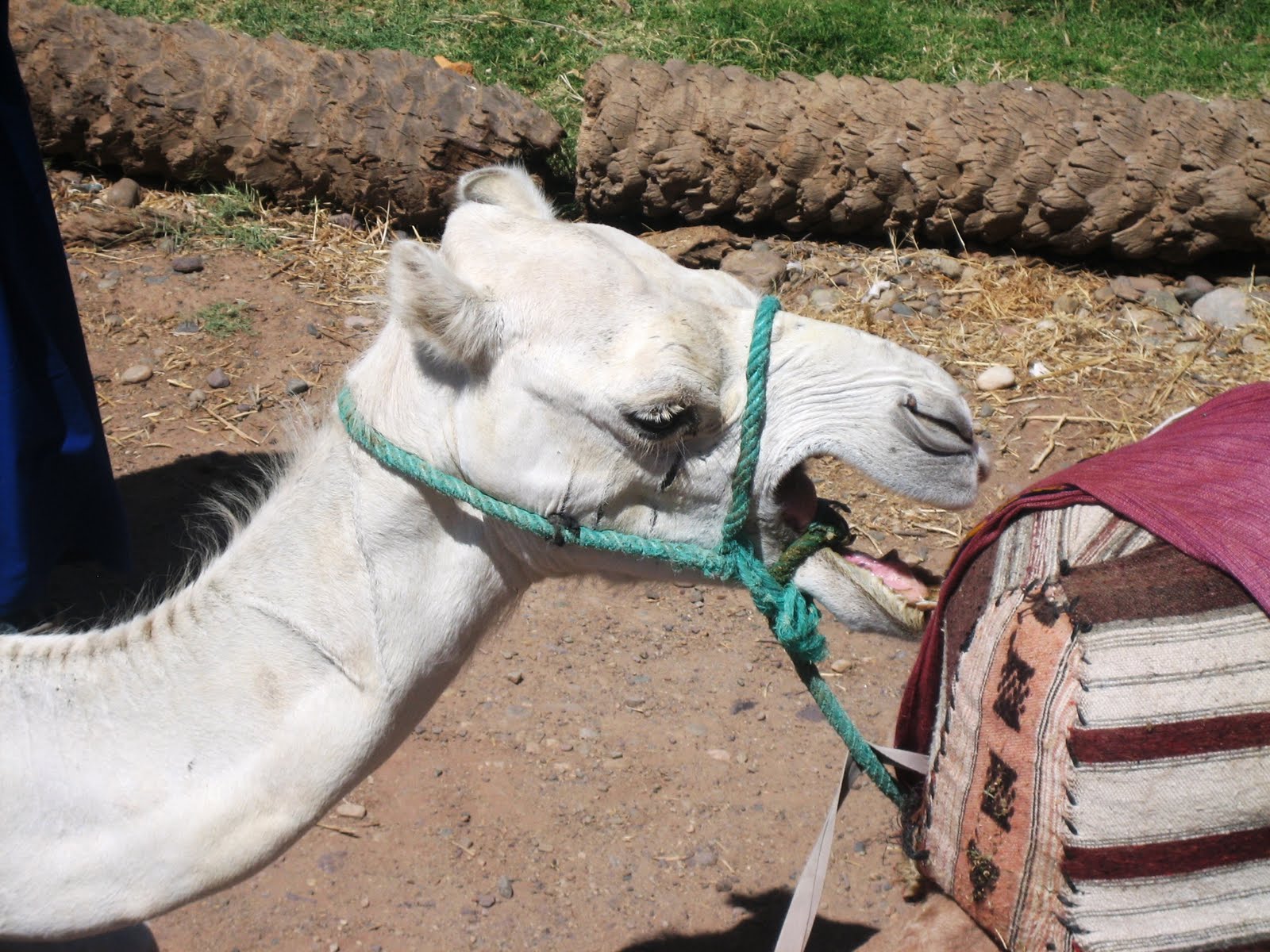
Camel ride in the Palm Groves


This is Sandra’s description of one of her trips in Morocco:

This was totally a fun experience.  We rode the camel for about an hour (much easier than riding a horse).  Following the ride we had lunch in a typical Moroccan home—seated on the floor, low tables, rugs, and ate with our hands.  We returned using ATVs—can only be describes as wild, dusty, and hot!

Sandra on her ATV


The "end" of this blog

Wednesday, September 15, 2010

Back at sea

We departed Casablanca last night at 2000; next port is Takoradi, Ghana, arriving one week from today. We are now in day 4A for the purpose of knowing what class day it is- I just taught one of my World Regional Geography classes. Before we get to Ghana in my World Regional Geography course I hope to discuss West Africa, colonialism, Ghana, and a little bit of South Africa, plus show a movie on Mecca. In my Oceans class I’ll be covering the Third UN Conference on the Law of the Sea and some of the maritime zones (baselines, territorial sea, and exclusive economic zone) during the next 3 classes.

With 6 class periods and up to 9 classes each period between 0800 and 1730 it is a busy time on board. Internet access is not very reliable, or fast when you do manage to get on, during day light hours. The best time to get fast service is before 0600.

Computer lab on the 6th deck

Tuesday, September 14, 2010

Hassan II Mosque

The third largest mosque in the world, next to Mecca and Medina (in Saudi Arabia) is located in Casablanca. It is named for King Hassan II, the father of the present king, who died in 1999. This magnificent building took only 6 years to build, with about 2500 artisans working 24/7. It is situated right on the ocean and at night emits a laser beam towards Mecca that can be seen for 35 km. About 25,000 people can fit inside the mosque with another 100,000+ outside.

Interior of the mosque


Moroccan orphanage

This is Sandra writing of her tour of an orphanage near Casablanca:
The orphanage is set up like a village; it is clean and quite lovely, with duplex one-story houses which have one “mother” for up to 8 kids. This “mother” takes a vow not to marry. And, the village has one “dad” figure. Within the village they had goats, chickens, a carpentry shop, blacksmith, and a school. One side of the village was for kids with mental illnesses.

There is great shame in the Moroccan culture to have a child out of wedlock. When it happens, the woman usually leaves her home town and goes to a city to have the baby, then she would leave it at the doorstep of a mosque.

Girl's room at the orphanage


Sandra with one of the orphanage kids

Monday, September 13, 2010

Marrakech experience

I just returned from a 2 day, one night, trip to Marrakech, one of the old and historic towns in Morocco. We had a large bus load of 39 people which made an intimate look at the narrow and windy alleys of this quaint town quite difficult. And, like many organized tours, the tour company laid on several “touristy” things, like belly dancing after dinner.

But, on the second day we had an interesting journey into the Atlas mts, a mt. chain that runs generally north-south in the interior of Morocco. While the coastal area (Rabat, Casablanca) enjoys a Mediterranean climate, if we were to have had time to crest the Atlas mts and venture further east we would have come to rather arid land and the Sahara. We did have the opportunity to spend a bit of the morning in a Berber village and although “staged” for us, we got inside a “typical” home and were shown the art of making mint tea. On the way to the village we stopped briefly at a road side store where many fossils were being sold. I did bargain for a fossil that had been found in the higher Atlas mts—it will be placed in my library next to the fossil I had purchased near Beirut.

As part of their grade, students are required to do some type of research and writing for their classes while on their field trips. For my two world regional geography classes I have established the theme of “place” and have asked my students to find some sub-theme, such as architecture, churches, the market place, gardens, etc that help define a culture. One of my students was along with me on our journey to the Berber village and was quite enthused with what she saw and she came up to me to say that she knew what her first writing was going to be on. It is an added dimension to teaching to have access to the students, and vice versa, outside the class room.

A fossil from the Atlas mountains, in Morocco
 
A Berber man and his donkey
 
Mimi, one of my students, at the mint tea ceremony